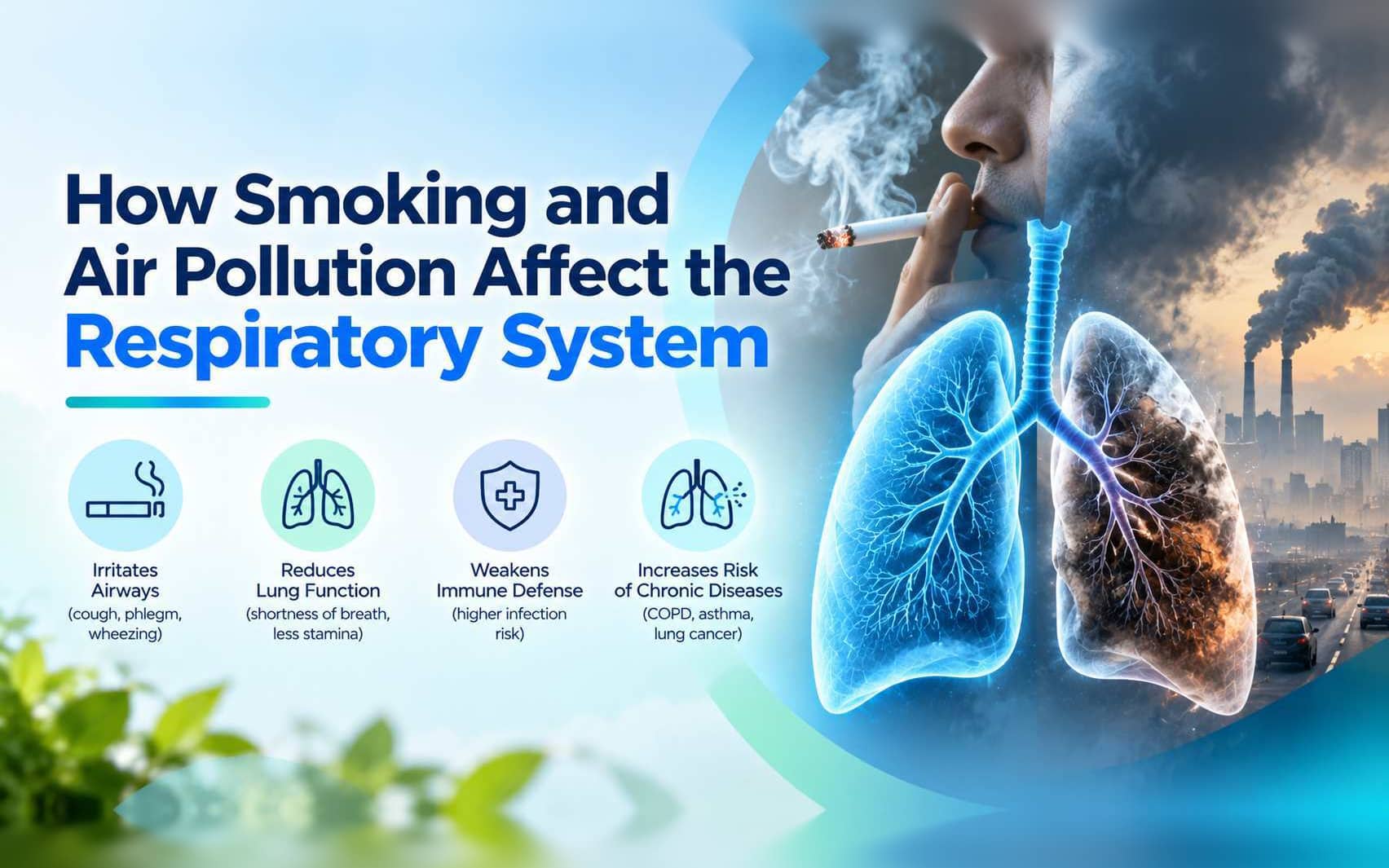
How Smoking and Air Pollution Affect the Respiratory System
By Dhanesh Suryawanshi · Chief Executive Officer, Know Your Health
You take roughly 20,000 breaths a day, and you almost never think about a single one of them. That's the beauty of a healthy respiratory system: it works quietly in the background, pulling in oxygen and sending out carbon dioxide without asking for attention.
But your lungs don't get to choose what comes in with that air. Cigarette smoke, traffic fumes, wildfire haze, dust, and even the smoke from a kitchen stove all travel the same route as the oxygen you need. Over time, some of those invisible visitors leave their mark.
In this post, we'll walk through how smoking and air pollution affect the respiratory system, what the early warning signs look like, and what you can realistically do to protect your lung health. We'll also share a little about how we approach this at Know Your Lung Health (Kylunghealth).
A Quick Look at How Your Respiratory System Protects Itself
To understand the damage, it helps to know what's being damaged. Your respiratory system isn't just a pair of lungs. It's a whole defense network:
- Your nose and throat filter and warm incoming air.
- Your airways (the windpipe and bronchial tubes) are lined with tiny hair-like structures called cilia. These sweep mucus, dust, and germs upward so you can cough or swallow them away.
- Your air sacs (alveoli) are where oxygen actually passes into your blood. There are millions of them, and they're delicate.
When this system is working well, most of what you breathe in gets caught and cleared before it causes trouble. Smoking and air pollution both overwhelm that defense, in slightly different ways.
What Smoking Does to Your Lungs
Cigarette smoke is a cocktail of thousands of chemicals, and according to the Centers for Disease Control and Prevention, many of them are known to cause cancer. But even before serious disease develops, smoking changes how the respiratory system behaves day to day.
It damages the cilia. Those tiny sweepers get paralyzed and eventually destroyed. Without them, mucus and trapped particles sit in your airways instead of being cleared out. That's a big reason smokers often develop a morning cough: the body is trying to do manually what the cilia no longer can.
It inflames the airways. Constant irritation causes swelling and extra mucus production. Over time, this can lead to chronic bronchitis, where a wet cough hangs around for months and keeps coming back.
It destroys air sacs. Repeated damage can break down the walls of the alveoli, leaving fewer and larger air spaces. This is called emphysema, and it makes it harder for oxygen to pass into the blood.
It raises the risk of infection. With weakened defenses, the lungs are more vulnerable to colds, bronchitis, and pneumonia, and recovery can take longer.
Smoking is the leading cause of COPD (chronic obstructive pulmonary disease), a progressive condition that makes breathing steadily harder. If you want to learn more about how it develops and what the early signs look like, we cover it on our COPD page.
What about vaping and secondhand smoke?
Smoking isn't only about cigarettes, and it doesn't only affect the person holding one.
Secondhand smoke exposes non-smokers, including children, to many of the same irritants. In kids, it's linked to more frequent coughs, wheezing, and respiratory infections, and it can make asthma worse.
Vaping is newer, and research is still catching up. What's already clear is that inhaling aerosolized chemicals isn't harmless for the airways, and vaping is associated with respiratory symptoms like cough and wheezing in some people. It's best not to assume it's risk-free.
What Air Pollution Does to Your Lungs
You don't have to smoke to expose your lungs to harmful particles. Air pollution is one of the biggest environmental risks to respiratory health, and it comes in several forms.
The main culprits
- Fine particles (PM2.5): These are microscopic particles, smaller than 2.5 micrometers, released by vehicles, industry, burning fuels, and wildfires. They're small enough to travel deep into the lungs, and some can even enter the bloodstream.
- Ground-level ozone: A gas formed when pollutants from cars and factories react in sunlight. It can irritate the airways and trigger coughing, throat irritation, and tightness in the chest.
- Nitrogen dioxide and sulfur dioxide: Gases from burning fuel that can inflame airways, especially in people who already have asthma.
- Dust, mold, and allergens: Not always counted as "pollution" in the traditional sense, but they can trigger similar irritation, particularly indoors.
The World Health Organization reports that the vast majority of the global population breathes air that exceeds its recommended guideline limits for pollutants, which means this isn't a problem limited to a few unlucky places. It touches almost everyone to some degree.
How pollution affects the respiratory system
The effects depend on how high the exposure is, how long it lasts, and how healthy your lungs are to begin with. Short-term exposure, like a few days of heavy smog or wildfire smoke, can cause:
- Coughing and a scratchy throat
- Wheezing or chest tightness
- Shortness of breath, especially during activity
- Flare-ups in people with asthma or COPD
Long-term exposure is more concerning. Years of breathing polluted air is associated with reduced lung function, higher rates of respiratory infections, and a greater risk of chronic lung disease. Children are particularly vulnerable because their lungs are still developing, and older adults and people with existing conditions tend to feel the effects sooner.
Don't forget indoor air
We often picture pollution as something outside, but indoor air matters just as much, since most of us spend the majority of our time inside. Common indoor sources include:
- Tobacco smoke
- Cooking, especially with solid fuels or poor ventilation
- Mold and damp
- Dust mites and pet dander
- Candles, incense, and some cleaning products
In many parts of the world, smoke from cooking fires is a major source of respiratory illness. Even in well-ventilated homes, simple habits like using the extractor fan while cooking can make a difference.
Smoking and Air Pollution Together: A Double Burden
Here's where it gets more serious. If you smoke and live or work in a polluted environment, your lungs are dealing with two sources of irritation at once. Both damage the airways, both increase inflammation, and both reduce the lungs' ability to clear what they inhale. Research generally shows that the combined effect can be worse than either exposure alone.
This is why people who smoke are often advised to be extra careful on high-pollution days, and why quitting becomes even more valuable when you live somewhere with poor air quality.
Early Warning Signs Your Respiratory System Is Under Strain
The tricky thing about lung damage is that it often builds slowly. Many people adjust to their symptoms without realizing how much they've changed. Here are signs worth paying attention to:
- A persistent cough that lasts more than three weeks, or a cough that returns again and again
- A "smoker's cough" that's become part of your normal morning routine
- Wheezing, a whistling sound when you breathe out
- Shortness of breath during things that used to feel easy, like climbing stairs
- Increased mucus, especially if its color or amount changes
- Frequent chest infections that seem to keep coming back
- Chest tightness, particularly on high-pollution days
If a cough has quietly become part of your life, it's worth asking whether it's been telling you something. We explain more on what counts as a persistent cough and why it matters in our guide to respiratory health screening.
What You Can Do to Protect Your Lung Health
The encouraging part is that your respiratory system responds well to better habits, and it's rarely too late to start. Here are practical steps, starting with the most impactful.
If you smoke, quitting is the single best thing you can do
Within weeks of stopping, circulation and lung function begin to improve, and the cilia gradually start working again. Over the longer term, the risk of lung disease drops significantly. Quitting is hard, and it often takes more than one attempt, so it helps to get support. Your doctor or local health services can offer options such as counseling and nicotine replacement.
Reduce your exposure to air pollution
- Check the air quality in your area before heading outdoors, especially if you have asthma or COPD. Many weather apps now display it.
- Avoid exercising near heavy traffic or during peak pollution hours.
- Wear a well-fitting mask (such as an N95 or equivalent) on very polluted or smoky days.
- Use a HEPA air purifier at home if you live in a high-pollution area.
- Keep windows closed during high-pollution periods, and ventilate when the air is cleaner.
Make your indoor air better
- Don't allow smoking inside your home or car
- Ventilate when cooking
- Fix damp and mold problems promptly
- Dust and vacuum regularly, ideally with a HEPA filter
- Choose fragrance-free cleaning products if they irritate your airways
Support your lungs day to day
- Stay physically active, since regular exercise helps lung capacity
- Stay up to date with recommended vaccinations, such as flu and pneumococcal vaccines
- Stay hydrated, which helps keep mucus thin and easier to clear
- Attend regular health checkups, especially if you have a history of smoking
The American Lung Association offers helpful resources on quitting smoking and improving air quality at home, and it's a good place to start if you want more detail.
Where Kylunghealth Fits In
At Know Your Lung Health, our mission is to help people understand their respiratory health a little better, without needing to book an appointment just to get started. Our free AI cough analysis lets you record a short cough sample on your phone and receive an easy-to-read respiratory risk overview.
For someone with a long-term smoking history, or who lives with poor air quality, a cough can become so familiar that it stops feeling like a symptom. A quick assessment can be a prompt to take that cough seriously and decide whether it's time to talk to a doctor.
We want to be clear about what this is and isn't. Kylunghealth is a screening support tool, not a diagnostic device. It can't tell you whether smoking or pollution has caused lung disease, and it doesn't replace a medical exam or lung function testing. You can read exactly how it works on our How It Works page.
The Bottom Line
Your respiratory system is remarkably resilient, but it isn't invincible. Smoking and air pollution both wear down its natural defenses, often quietly and over many years. The good news is that small, consistent changes, like quitting smoking, cleaning up your indoor air, and paying attention to a cough that won't go away, can make a real difference.
If your cough has been around longer than it should, or you've simply never taken a close look at your lung health, a good first step is to listen to what your body is telling you.
Curious what your cough might be telling you? Try Kylunghealth's free AI cough analysis and take your first step toward understanding your respiratory health.
Next step
Ready to capture a cough sample?
Start a free Kylunghealth assessment and generate a clinician-ready respiratory risk snapshot in minutes.

FAQ
Frequently asked questions
Smoking damages the cilia that clear mucus, inflames the airways, destroys air sacs, and increases the risk of infections and chronic conditions like COPD.